Protecting structures, vehicles and individuals from potential blast hazards is important. However, to fully understand how to ensure safety, you must know which blast mitigation materials will work best for your application. Blast protection comparison is the first step toward creating a secure and safe environment.
This guide provides the information needed to make an informed decision. Here’s what you need to know to make a blast mitigation material comparison for wire rope vs. polyurea vs. steel plating.
Understanding Blast Mitigation
Explosions release high-pressure blast waves, which last a short time but can significantly damage structures by transmitting the blast’s energy. The structural material’s response depends on the pressure and impulse of the wave and the strength and composition of the structure.
Here’s how a blast works and how to mitigate its effects:
- An explosion creates a shock wave.
- If a blast wave hits an object, it increases the pressure on its surface.
- A portion of the wave transmits into the object, and the rest is reflected.
- The blast wave energy transfers to a structure, causing it to deform.
- The structure’s response depends on the material’s strength, flexibility and toughness.
- Blast resistance success is determined by the ratio of pressure to velocity.
For these reasons, blast mitigation materials play a pivotal role in determining how a structure or object reacts to an explosion. While individual needs vary based on specific requirements, there are a few key factors to consider when comparing wire rope, polyurea, and steel plating for blast mitigation.
Wire Rope
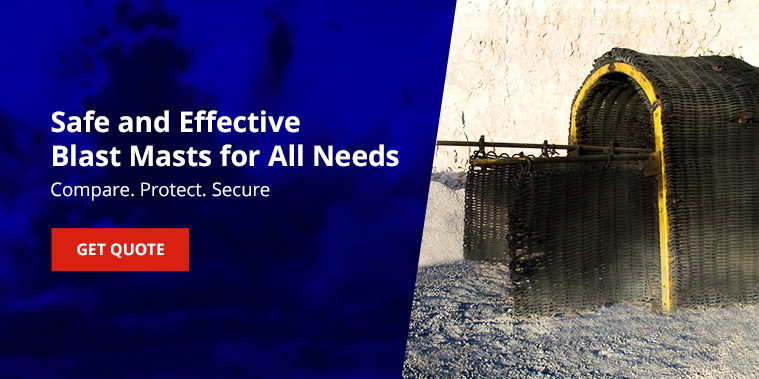
Wire rope systems use woven wire to catch debris and contain the effects of a blast. Wire rope is reusable and flexible, protecting the environment surrounding controlled detonations and other hazardous blasts.
How Wire Rope Absorbs Blast Energy
The wire rope’s woven steel construction catches rocks and other debris, preventing damage and injuries. The wire rope barrier effectively contains the blast’s force, as the small holes within it help gases from an explosion escape. Flexible mats like this can conform to any surface or terrain, giving you better contact for blast protection.
Wire rope absorbs a blast’s energy by deforming, turning the blast’s kinetic energy into plastic deformation, which permanently changes a material’s size and shape — it doesn’t return to its original form. In other words, the wire rope absorbs the blast, the force of which stretches and deforms the wires as the blast’s energy dissipates.
Applications and Other Factors
Wire rope blast mitigation materials can be implemented as a preventive measure in several industries and situations, including:
- Protection: Wire rope can protect buildings, rooftops or other structures from impact or explosions.
- Construction and pipelines: Protect the surrounding properties and environment from blasting activities.
- Security: Use wire rope materials to create a fire and explosion-proof security barrier.
- Events: Use at temporary events that require blast safety measures.
- Military and bomb disposal: Prevent blast damage, protect people, and conform to difficult terrains.
Polyurea Coatings
Polyurea is a versatile technology-based coating applied as a fast-curing and very durable liquid. Its chemical resistance and ability to resist water make it an innovative blast protection barrier. Polyurea’s applications for blast resistance are growing.
Polyurea’s Energy Absorption
Similar to wire rope, polyurea absorbs an impact’s energy via plastic deformation by catching dangerous fragments. However, in a wire rope vs. polyurea comparison, the similarities end there. Polyurea’s effectiveness can depend on a wide range of factors, including the substrate properties and the thickness of the coating itself.
The detailed molecular structure of polyurea coatings contains both hard and soft segments, allowing them to absorb blast impact energy and disperse it safely. Polyurea bolsters blast security with a watertight surface that reduces the pressure on the underlying structure, maintaining the aesthetics of the surface structure and protecting lives.
Applications and Other Factors
Polyurea’s highly modular physical composition makes it adaptable to many different areas and industries. It can also work in conjunction with other layers in complex constrained-layer damping coatings to further enhance energy absorption. It is widely used in the following areas:
- Concrete and masonry structures, composite materials and metal components with complex alloys.
- Industrial applications where steel plates and large metal structures need enhanced protection.
- Commercial applications like farm equipment, truck lining and other containment systems.
- Military installations, protective rooms and armored vehicles that encounter ballistic impact risks.
When reviewing polyurea for blast and protection needs, especially when comparing wire rope vs. polyurea, remember that wire rope can conduct electricity, while polyurea is not. Polyurea is more effective for protecting and sealing a surface from blast impact, while wire rope is more commonly used for load and structural support.
Steel Plating
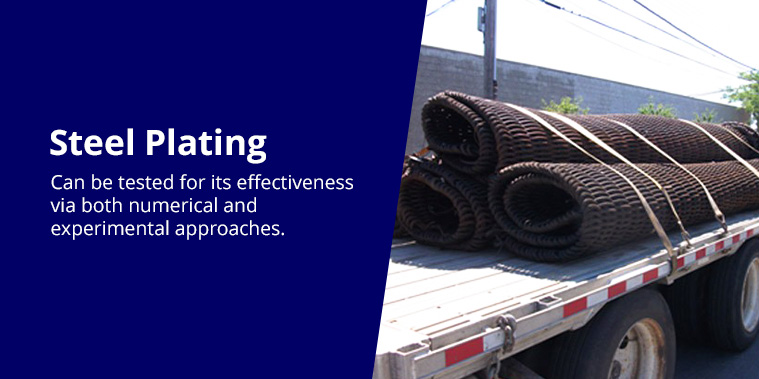
Steel plating for blast protection is a specially designed defense method that provides a surface that absorbs and dissipates the explosive impact energy. Blast protection steel is crafted through heat treatment and can be tested for its effectiveness via both numerical and experimental approaches.
How Steel Plating Absorbs Blast Energy
Steel plating absorbs blast energy through the strength and durability of its material. Ballistic steel plating can be made blast-resistant through either hardening or tempering.
Hardening involves heating to a temperature that allows the cubic iron crystal to change form. Once the steel reaches the austenitic state, it is quickly cooled again. This process essentially freezes carbon atoms as a solid within the iron itself, which contributes to its high strength in resistance. Tempering steel involves reheating the steel afterwards to make it more resistant to cracking.
The best approach for blast resistance depends on the steel’s quality and the specific requirements based on the ballistic threats.
Applications and Other Factors
Blast protection steel is designed to withstand high-energy impact and protect lives from hazards such as mines, grenades and other explosive devices. You may also find them in the following areas:
- Armored vehicle flooring to protect against improvised explosive devices.
- Civilian and government buildings that may need protection from threats.
- Specialized storage units such as bank vaults.
Which Blast Mitigation Materials Work Best?
Any blast protection comparison should consider your specific needs and the key performance indicators (KPIs) needed to determine which material will best achieve those needs. These measures help assess the effectiveness of a blast mitigation plan in reducing the impact on a structure.
Consider these metrics when choosing your blast mitigation materials:
- Energy absorption: This refers to the amount of energy the mitigation material absorbs or dissipates to prevent it from transferring to what is being protected.
- Angle of incidence: Think about the angle at which the blast wave would be hitting the mitigation material surface.
- Peak pressure reduction: Compare the reduction in pressure for the protected structure to the pressure when unprotected.
- Loading duration: This refers to the amount of time a potential blast wave will exert pressure on the structure.
- Standoff distance: This is the distance between the blast point and the structure being protected.
Safe and Effective Blast Masts for All Needs
Blast mitigation materials are essential across a wide range of industries. TM International, LLC, provides a range of safe and effective blast mats to various businesses, organizations, and government agencies that need them. Our blast mats adhere to strict quality standards for peace of mind.
Contact us and get a quote today!