How Do Blast Mats Compare to Blast Walls for Debris Containment?
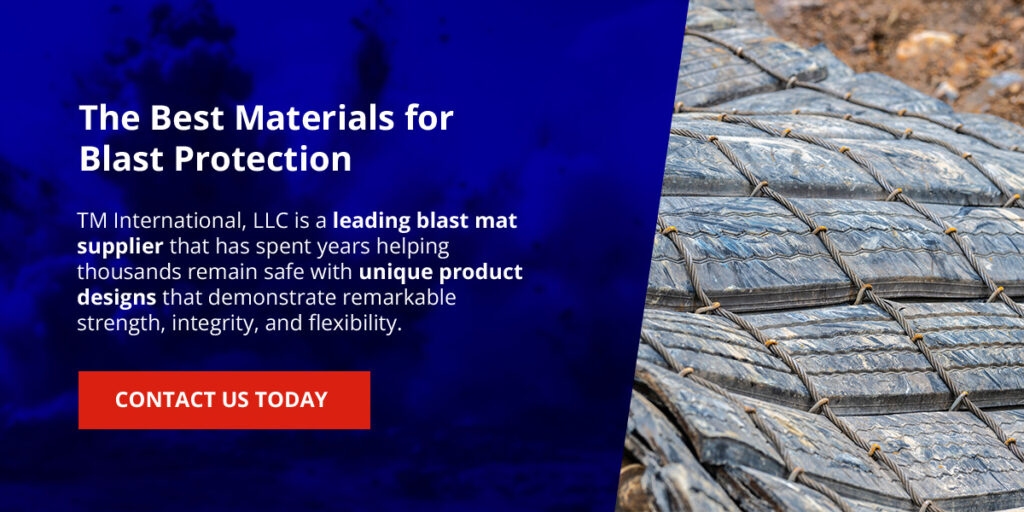
Blast mats are primarily for vertical containment, while blast walls are for horizontal containment. Both solutions contain debris effectively, but matching them to the right application is essential. Blast mats are the ideal solution in most scenarios because they offer direct surface containment and block debris at the source of a blast. Blast walls are more effective at reducing peak overpressure from a high-intensity blast.
What Are the Main Differences Between Blast Mats and Blast Walls?
Blast mats and blast walls differ in the following ways:
- Materials: Rubber or wire ropes make up blast mats, while blast walls are made of concrete or hardened steel.
- Placement: Blast mats rest over a blast hole to prevent flyrock and debris from becoming airborne. Blast walls sit between your blast site and the surrounding buildings or area you want to protect.
- Shock absorption: A blast mat provides high local damping, absorbing and dissipating more blast energy. This absorption prevents the kinetic energy from transferring to what’s beneath or behind the mat. A blast wall provides high-pressure reflection and attenuation. This allows the wall to reduce the overall force of a blast and bounce a significant portion of the pressure wave away from the protected area.
- Installation: Blast mats are temporary and lightweight, allowing you to transport them between worksites easily. Blast walls are permanent or semi-permanent barriers for hazardous zones.
- Target hazards: Hazards such as high-frequency shockwaves, flyrock and near-field pressure require blast mats for containment. Blast walls are better for managing far-field blast waves, debris and structural damage.
- Cost: Blast mats typically come at a lower cost than blast walls.
- Environmental impact: A blast mat helps protect the environment from dust and debris during a blast. Blast walls tend to have a higher carbon footprint due to their size and construction, but they are necessary in high-blast areas or permanent facilities.
When Is a Blast Mat the Best Option?
A blast mat is the best option for controlled explosions common in these applications:
- Small or mid-range blasts
- Surface-level blasts
- Road cutting
- Trenching
- Drilling
- Mining
- Construction
- Demolition blasts in confined spaces
When Should You Use a Blast Wall?
You should use a blast wall for perimeter protection or high-intensity applications such as the following:
- High-impact blasting
- Urban demolition
- Industrial sites with high-risk hazards
- High-security areas, such as airport parking lots and military or government installations
- Petrochemical security
Protect Your Worksite With Heavy-Duty Blast Mats and Blast Walls From TM International, LLC
Blasting requires heavy-duty debris containment solutions. TM International, LLC offers wire rope blast mats and steel cable blast walls for reliable blast mitigation. Contact us to learn more about our dependable blast shields.